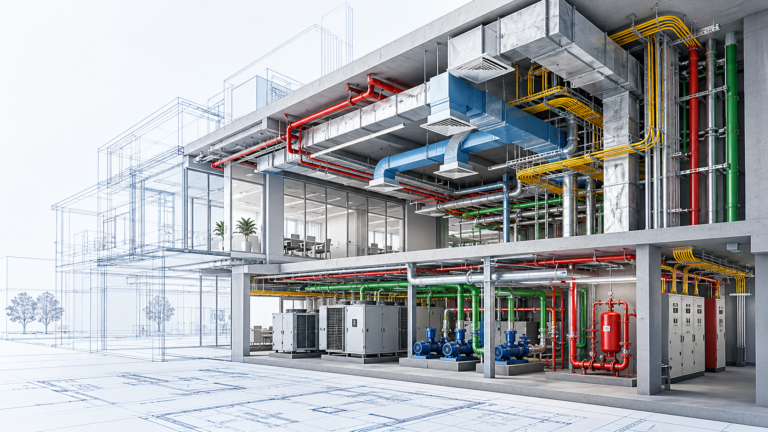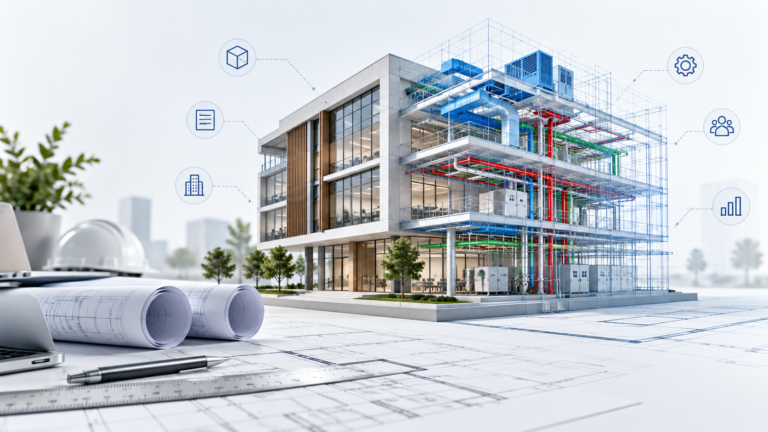
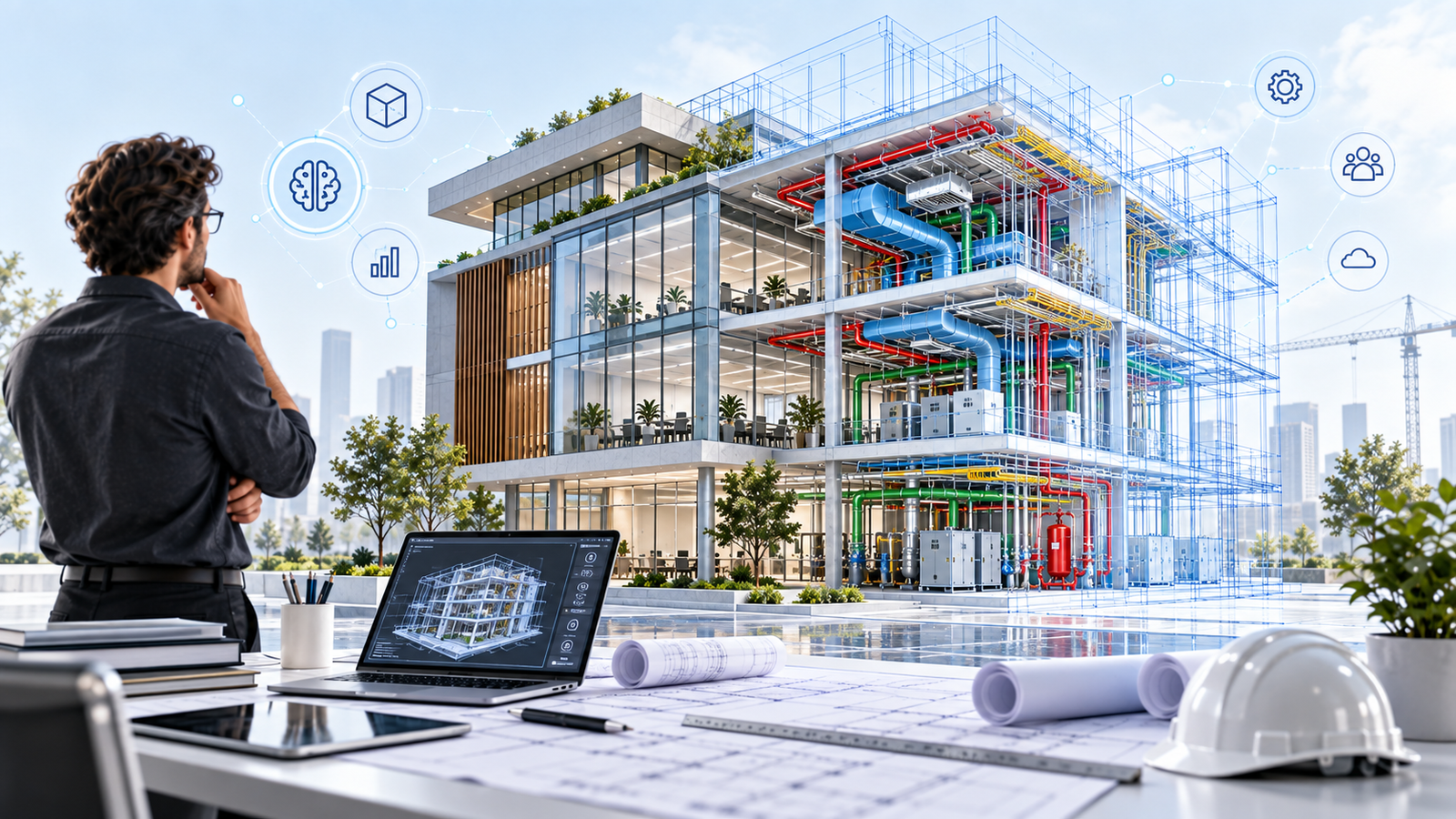
AI in construction uses artificial intelligence, machine learning, computer vision and automation to improve building design, project planning, cost estimation, safety monitoring and construction management. Looking toward 2027, AI is becoming increasingly integrated with Building Information Modeling (BIM), digital twins, robotics and cloud platforms, creating opportunities for engineers, architects, contractors and construction professionals worldwide.
The construction industry is entering a new phase of digital transformation.
For decades, construction projects have depended heavily on manual documentation, conventional scheduling, repetitive engineering processes and fragmented information.
Artificial intelligence offers opportunities to change how these activities are performed.
Today, AI-powered technologies can support architectural design, analyse project information, monitor construction progress, automate selected BIM tasks and identify potential project risks.
Emerging developments suggest that 2027 could mark another important stage in the transition from isolated digital tools to increasingly connected and intelligent construction workflows.
However, actual industry adoption remains uneven.
Understanding where AI is already delivering value—and where its capabilities remain experimental— is essential for professionals preparing for the future of construction.
1. What Is Artificial Intelligence in Construction?
Artificial intelligence in construction refers to using intelligent computer systems to analyse information, recognise patterns, generate content, automate selected activities and support decisions throughout the construction project lifecycle.
Unlike conventional automation, which follows predefined instructions, AI systems can use techniques such as machine learning to identify patterns in data.
Generative AI can produce text, images or design-related content. Computer vision can interpret photographs and video. Predictive models can identify patterns associated with project delays, equipment failures or cost changes.
These technologies serve different purposes.
| AI Technology | Construction Application |
|---|---|
| Machine learning | Risk identification and predictive analytics |
| Generative AI | Documentation and design assistance |
| Computer vision | Site monitoring and visual progress analysis |
| Natural language processing | Searching construction documents |
| Predictive AI | Schedule and cost-risk analysis |
| Agentic AI | Performing connected, multi-step digital tasks |
| AI-powered robotics | Supporting selected physical construction activities |
AI should complement professional engineering expertise rather than replace technical verification, safety procedures or regulatory compliance.
2. How Quickly Is AI Being Adopted in Construction?
Industry research shows considerable interest in AI, although large-scale implementation remains limited.
The Royal Institution of Chartered Surveyors’ 2025 AI in Construction Report surveyed more than 2,200 construction professionals internationally.
Its findings included:
- Approximately 45% of respondents reported no organizational AI implementation.
- Another 34% reported that their organizations were experimenting with AI through early pilot projects.
- Only around 1% reported organization-wide deployment across projects.
- Skills shortages were identified as a major obstacle by 46% of respondents.
The survey contained a substantial proportion of UK respondents, so its findings should not be interpreted as precise adoption rates for every country.
Nevertheless, the results reveal an important distinction: industry interest is considerably greater than widespread implementation.
For organizations preparing for 2027, this creates an opportunity to develop practical capabilities while many competitors are still evaluating the technology.
The next challenge is converting experimentation into measurable project improvements.
Major Applications of AI in Construction
3. AI in Architectural Design and Generative Design
Architectural design is among the areas where AI is already influencing professional workflows.
Traditional architectural design requires considerable time to evaluate site conditions, building layouts, environmental performance and alternative design proposals.
AI-assisted design tools can accelerate parts of this process.
For example, architects may use intelligent systems to explore building orientations, compare massing alternatives and identify environmental constraints earlier in the design process.
Autodesk Forma demonstrates these capabilities through cloud-based site planning and AI-assisted analysis.
Its environmental analysis capabilities include sunlight, wind, noise and carbon-related assessments. Some rapid analyses use machine-learning predictions, allowing designers to investigate multiple possibilities before conducting more detailed analysis.
How AI-assisted architectural design works
Consider an architect developing a residential project.
The architect establishes the site boundary, approximate building requirements and relevant design constraints.
AI-assisted analysis can help compare alternative building arrangements and identify potential environmental advantages or disadvantages.
The architect then evaluates the results against planning regulations, accessibility requirements, engineering constraints, costs and the client’s objectives.
AI accelerates the exploration process.
However, the architect remains responsible for deciding which design satisfies the complete project requirements.
This distinction becomes particularly important when comparing generative design and generative AI.
Generative design usually explores alternatives using defined parameters and optimization rules. Generative AI produces content based on learned patterns.
The two approaches may increasingly work together.
4. AI in BIM: The Evolution of Intelligent Building Models
Building Information Modeling is becoming an important foundation for AI-powered construction.
BIM organizes digital information about buildings and infrastructure, including geometry, materials, components, systems and related project information.
When AI interacts with structured BIM information, opportunities emerge for more intelligent modelling and information management.
Repetitive activities involving schedules, parameters, documentation and model queries are particularly relevant.
An important development is Autodesk Revit 2027, released in April 2026.
The release introduced Autodesk Assistant as a technology preview, providing AI-supported interaction within the modelling environment.
Its capabilities include querying model information, assisting with schedules, editing supported parameters and providing contextual workflow guidance.
AI-assisted BIM workflows
A BIM professional might use supported AI functionality to:
- Retrieve information from a building model.
- Identify elements matching specific conditions.
- Generate selected documentation.
- Automate repetitive model-management activities.
- Review the results before approving changes.
These capabilities represent a gradual movement toward intelligent BIM workflows.
However, AI functionality varies between software versions, subscription arrangements and technology-preview programs.
Furthermore, generating a response about a building model is different from verifying that the building is structurally sound or that its engineering systems meet applicable standards.
For a complete introduction, read The Engineer Guide’s related article, What Is BIM? A Practical Guide to Building Information Modeling.
5. AI in Construction Project Management
Construction project managers coordinate schedules, budgets, contractors, material deliveries, documentation and project risks.
These activities generate substantial amounts of information.
AI-powered construction management systems can help organize and analyse selected project information, potentially improving decision-making.
Three applications are particularly relevant.
Predictive scheduling
Predictive models can analyse historical project information and identify patterns associated with construction delays.
Potential inputs include planned durations, actual progress, resource availability, project dependencies and previous scheduling performance.
However, forecasts depend on data quality and whether past projects are sufficiently comparable.
Automated construction documentation
Generative AI can assist with meeting summaries, document searches, draft reports and information retrieval.
For example, a project manager could search approved project documentation for information related to a particular technical query.
The response should remain connected to its original source so that the project team can verify it.
Construction risk management
Predictive analytics can help identify combinations of factors associated with increased project risk.
These might include repeated schedule changes, unresolved technical queries or delayed approvals.
Risk predictions should support experienced project managers rather than automatically determine important project decisions.
6. AI in Construction Safety and Site Monitoring
Construction sites are dynamic environments involving workers, equipment, changing site conditions and multiple contractors.
Computer vision offers opportunities to analyse images and video collected from construction sites.
Depending on the system and its training, potential applications include identifying selected site conditions, analysing equipment movement and highlighting possible safety concerns.
However, computer vision systems can produce false positives and miss dangerous conditions.
Their performance can also be affected by lighting, image quality, camera positioning and changing construction environments.
AI monitoring should therefore support—not replace—qualified safety personnel, established inspections or legally required safety procedures.
Construction organizations should also address worker privacy, appropriate monitoring policies and applicable local laws before deploying these technologies.
7. AI for Construction Progress Monitoring
Accurately understanding construction progress is essential for project delivery.
Traditional progress monitoring often involves manual inspections, photographs, written reports and meetings.
AI-powered visual monitoring systems can connect site imagery with progress information.
For example, OpenSpace provides visual construction documentation and AI-supported progress-monitoring capabilities.
Its progress-tracking offering combines captured imagery, analytics and human review to help teams compare actual construction progress with planned activities.
Practical application
Consider a high-rise construction project.
The project team captures construction-site imagery at regular intervals.
A compatible monitoring system processes the information and organizes it according to project locations and activities.
Project managers can then compare recorded conditions with planned construction milestones.
This may help identify incomplete activities, investigate delays and improve communication between contractors.
The accuracy of progress assessment still depends on the information collected and the verification process.
AI Construction Tools to Know for 2027
8. AI Tools for Architects, Engineers and Contractors
There is no single AI platform capable of handling every construction activity.
Different tools address different stages of the project lifecycle.
The following examples demonstrate technologies relevant to construction professionals preparing for 2027.
| Tool or Platform | Primary Application | Intended Users |
|---|---|---|
| Autodesk Forma | AI-assisted planning and environmental analysis | Architects and designers |
| Autodesk Revit 2027 | AI-assisted BIM activities through Autodesk Assistant | Architects and BIM professionals |
| OpenSpace | Visual documentation and progress monitoring | Contractors and project managers |
| Procore Assist | Conversational project-information retrieval and reporting | Construction management teams |
Availability note: Some capabilities are offered as technology previews or depend on specific subscriptions. New activations of the legacy Procore Assist service are currently paused while its next-generation AI offering is developed.
Autodesk Forma
This platform supports early-stage architectural planning and environmental analysis.
It is relevant to professionals evaluating building layouts, environmental conditions and early design alternatives.
Revit and Autodesk Assistant
Revit 2027 integrates AI-assisted interaction with building-model information.
This development is particularly relevant to BIM professionals interested in natural-language interaction, model information retrieval and supported automation.
OpenSpace
OpenSpace uses visual site documentation and AI-supported analysis to help construction teams understand physical project conditions.
It is relevant to progress monitoring, project records and site coordination.
Procore Assist
Procore provides construction-management software with AI-related capabilities.
Its legacy Assist service can retrieve selected project information and generate supported reports, subject to existing permissions and product limitations.
These examples illustrate different applications rather than establishing a universal ranking of construction AI software.
When comparing products, prioritize your actual workflow requirements, integrations, data security and total implementation costs.
Emerging AI Construction Trends for 2027
9. Agentic AI and Autonomous Digital Workflows
One of the most interesting emerging technologies is agentic AI.
Unlike a conventional chatbot that primarily responds to questions, an AI agent can potentially use connected tools to complete multiple steps toward a defined objective.
In construction, this could eventually support increasingly sophisticated information-management workflows.
For example, an appropriately configured agent might retrieve project information, organize selected documentation and prepare a draft report for professional review.
The introduction of a Model Context Protocol server as a technology preview in Revit 2027 is relevant to this direction.
MCP provides a standardized approach for connecting AI systems with supported applications, tools and information sources.
However, fully autonomous construction engineering remains substantially different from automating administrative tasks.
Important decisions involving structural integrity, life safety and regulatory compliance require appropriately qualified professionals.
10. AI-Powered Digital Twins
Digital Twins represent another important area of construction technology.
A Digital Twin is a connected digital representation of a physical asset or system.
Building Information Modeling can provide structured asset information that contributes to a Digital Twin environment.
When operational information is incorporated through connected systems and sensors, a Digital Twin can support building-performance analysis and asset management.
AI creates additional opportunities to analyse operational information and identify potential abnormalities.
For example, an intelligent building-management system could analyse historical and current HVAC operating data to identify patterns associated with equipment-performance problems.
However, not every BIM model qualifies as a Digital Twin.
The additional operational connections, available information and functional capabilities determine what a particular system can achieve.
11. AI in Construction Cost Estimation
Estimating construction costs requires information about quantities, labor, materials, equipment, project conditions and market pricing.
AI may support this process by organizing historical information and identifying patterns across comparable projects.
When connected with reliable quantity information, predictive systems could support preliminary cost scenarios.
However, the system must account for important differences between projects.
A hospital constructed in one country may involve substantially different costs, regulations and technical requirements from a residential development elsewhere.
AI-generated estimates should therefore be reviewed using current local market information and professional quantity-surveying expertise.
12. AI, Robotics and Automated Construction
Construction robotics represents another emerging opportunity.
AI can support selected robotic activities by processing sensor information, interpreting surroundings and assisting with automated operations.
Potential applications include repetitive material-handling activities, selected surveying operations and automated construction processes.
However, physical construction environments are difficult to standardize.
Weather, site conditions, human activity and changing work areas introduce complications that do not exist in controlled manufacturing environments.
Consequently, the adoption of autonomous construction robotics is likely to differ considerably between construction activities and project types.
Benefits and Challenges of AI in Construction
13. What Are the Main Benefits of AI in Construction?
AI can potentially improve several aspects of construction delivery.
| Potential Benefit | Example |
|---|---|
| Productivity | Automating repetitive documentation |
| Planning | Evaluating schedule-risk patterns |
| Design exploration | Comparing multiple design alternatives |
| Information retrieval | Searching project documentation |
| Progress visibility | Analysing construction-site imagery |
| Coordination | Supporting model-information checks |
| Sustainability | Accelerating preliminary environmental analysis |
These benefits are opportunities rather than guaranteed results.
Actual performance depends on implementation quality, available data, project characteristics and professional oversight.
14. What Are the Biggest Challenges?
AI adoption introduces significant technical and organizational challenges.
Poor data quality: Incomplete or inconsistent project information can produce unreliable AI outputs.
Integration: Construction information is frequently distributed across multiple software systems and organizations.
Skills shortages: Organizations need professionals who understand both construction workflows and AI limitations.
Confidentiality: Project documents may contain commercially sensitive information.
Reliability: Generative AI can produce convincing but incorrect answers.
Accountability: Organizations must define responsibility for reviewing AI-supported decisions.
These concerns are increasingly reflected in professional standards.
The RICS professional standard for the Responsible Use of Artificial Intelligence in Surveying Practice took effect on March 9, 2026.
It addresses matters including governance, professional judgment, system management, reliability and communication.
Construction organizations should establish similar safeguards appropriate to their professional activities and jurisdictions.
AI in Construction Careers
15. Will AI Replace Construction Engineers?
AI is expected to change construction-related professional activities, but its impact will vary between roles and organizations.
Repetitive documentation, routine information retrieval and selected analytical activities are particularly suitable for automation.
However, engineering also requires technical judgment, coordination, communication, accountability and an understanding of complex physical conditions.
For example, AI may help organize structural information, but a qualified structural engineer remains responsible for determining whether a design satisfies applicable engineering requirements.
Professionals who understand both their engineering discipline and digital technologies may therefore find new opportunities.
The relevant question for students is not simply whether AI will replace engineers.
It is which skills will remain valuable as increasingly sophisticated technologies enter professional workflows.
16. Essential AI Skills for Construction Professionals
Construction professionals do not necessarily need advanced programming knowledge to begin working with AI.
However, foundational AI literacy is becoming useful.
| Professional Area | Relevant Skills |
|---|---|
| Architecture | AI-assisted design and environmental analysis |
| Civil engineering | Construction data analysis and BIM |
| Structural engineering | Structural fundamentals and computational workflows |
| MEP engineering | Revit MEP, coordination and automation |
| BIM coordination | Model management, Navisworks and information verification |
| Project management | Data analysis and AI-assisted reporting |
| Digital construction | BIM, cloud collaboration and automation |
Professionals interested in developing the BIM foundation behind these technologies can explore relevant CADBIM Centre BIM training programs.
For discipline-specific learning, the following pathways provide additional information:
Architectural BIM Live International Program
Structural BIM Live International Program
Electrical BIM Live International Program
These programs are learning options; they should not be confused with independent AI-specific certifications.
How Construction Companies Can Prepare for AI in 2027
17. A Practical AI Implementation Roadmap
Construction organizations can begin implementing AI without attempting to transform every department simultaneously.
A controlled implementation process is generally more practical.
Step 1: Identify a measurable problem. Select one repetitive or information-intensive workflow, such as document retrieval or progress reporting.
Step 2: Evaluate available information. Establish whether the organization has accurate, accessible and appropriately controlled data.
Step 3: Choose an appropriate technology. Select a product based on the actual problem, integration requirements and security considerations.
Step 4: Conduct a limited pilot. Test the system on an appropriately selected project or workflow.
Step 5: Establish professional review. Define who checks generated outputs and what decisions require additional verification.
Step 6: Measure results. Compare performance using relevant indicators such as processing time, error rates and staff effort.
Step 7: Expand carefully. Broaden implementation only when the pilot demonstrates meaningful benefits and manageable risks.
This approach helps organizations separate technological possibilities from measurable business value.
Frequently Asked Questions
What is AI in construction?
AI in construction involves using technologies such as machine learning, computer vision and generative AI to support activities including architectural design, project planning, cost estimation, documentation, safety monitoring and construction management.
How is AI used in construction projects?
AI can support construction projects through predictive scheduling, document analysis, design exploration, progress monitoring and selected automation activities. Its effectiveness depends on project information, implementation quality and professional verification.
What are the best AI tools for construction in 2027?
The appropriate tools depend on the intended application. Autodesk Forma supports AI-assisted design analysis, Revit includes emerging AI-supported BIM capabilities, and OpenSpace supports visual construction monitoring. Construction-management platforms also offer specialized AI functionality.
Can AI replace construction project managers?
AI may automate selected administrative and analytical tasks, but construction project management also requires leadership, negotiation, technical understanding, judgment and accountability. AI is better understood as a technology that can change how project managers perform their work.
How does AI work with BIM?
AI can interact with structured BIM information to support activities such as model queries, documentation, selected automation and information analysis. Integration depends on the capabilities of the relevant BIM platform.
Is AI in construction suitable for small companies?
Yes, provided that implementation is proportionate to business requirements. Smaller organizations may benefit from starting with limited applications such as document organization or reporting before investing in more complex technologies.
What is the future of AI in construction?
Looking toward 2027, important developments include deeper AI integration with BIM software, agentic workflows, intelligent project-information systems, AI-powered Digital Twins, predictive analytics and increasingly connected construction platforms.
Conclusion: The Future of AI in Construction
Artificial intelligence is becoming an increasingly important part of the construction industry’s digital transformation.
Its applications now extend from early architectural design to construction documentation, project management, progress monitoring and building operations.
Looking toward 2027, the connection between AI, BIM, automation, Digital Twins and cloud-based project information is likely to become particularly important.
However, the future of construction will not be determined by AI software alone.
It will depend on how effectively engineers, architects, contractors and project managers combine emerging technology with professional expertise.
For construction professionals, developing strong engineering knowledge alongside BIM, automation and AI literacy provides a practical foundation for participating in this transition.
The future of AI in construction is not simply automated construction. It is better-informed construction supported by intelligent technology and accountable professionals.